No matter whether you are a small business owner or a large enterprise, ranking higher on Google's Search Engine Results Pages (SERPs) is their foremost goal because it determines how much organic traffic you are getting. As per the recent survey, it was found that 70% of the people do not search beyond the first page of results.
But why do businesses care about their Google ranking? To grow business you need leads and you will most likely miss out the potential leads if you are not on the first page of search results. According to BrightEdge, the statistics show 53% of all trackable traffic comes from an organic search and the Advanced Web Ranking reveals that the first position on Google captures 28.5% of all clicks.
In 2024, it becomes more complex and challenging to grow organically due to constant algorithm updates and increased competition from AI-generated content.
Now you must be wondering “What is the trick or tips to rank higher on Google?” Well to give you proper insights, we have made this comprehensive guide that will help you improve your site traffic and to rank your page higher than your competitors.
But what are we going to talk about in this guide? We will let you understand recent Google’s algorithm changes/core updates, how to optimize your website as per user intent, uses of right SEO tools and how to continuously refine your strategy based on data. This is a bit of a long guide but it will be worth your business strategic growth.
Well if you are looking for SEO Experts who can handle your digital marketing or you want a solution for any type of IT services like website development or complete ERP solution. You can get in touch with our team at +91 9315604995.
Let’s get started
Google’s Major Core Update in 2024
Whenever Google comes up with an update, some websites get badly affected while others see no significant change. But why is it like this? Basically, Google wants to provide the best quality experience to its end users and to do so they have to create certain policies and rules.
For example, Google introduced E-E-A-T, which stands for Experience, Expertise, Authoritativeness, and Trustworthiness. The main purpose of this update was to evaluate web content’s overall quality and credibility. Whereas, it is not a direct factor but if you optimize it accordingly it will indirectly impact your site search performance. Now let's talk about some other important updates
- Google Hummingbird 2.0: Hummingbird was launched in 2013 and was designed to understand search queries better and match them to content. In 2024 Hummingbird 2.0 was released to improve Google’s ability to understand user intent, especially in voice search and conversational queries. Comscore says by 2024 over 50% of all searches will be voice-based so you need to optimize content for natural language processing.
- BERT (Bidirectional Encoder Representations from Transformers) Update: BERT was launched in 2019 and allowed Google to understand the context of words in a sentence which makes it better at understanding user intent. In 2024 BERT was updated to be even better at handling complex queries, especially prepositions like “for” and “to” which can change the meaning of a search. Now you need to focus on clear and concise language that can answer user questions directly.
- Core Web Vitals Update: Core Web Vitals which measures the speed, responsiveness and visual stability of web pages has been emphasized more in 2024. Google has added new metrics to measure user experience including Interaction to Next Paint (INP) Largest Contentful Paint (LCP), First Input Delay (FID), and Cumulative Layout Shift (CLS). According to Portent, websites that load in 1 second have 3x more conversions than websites that load in 5 seconds so speed optimization is more important than ever.
- Helpful Content Update 2.0: This update was first launched in 2022 to prevent content created for search engines (not users) from ranking. In 2024 Google has taken it further by refining its ability to identify and penalize content that lacks substance. According to the Demand Metric survey, 80% of consumers prefer to get information from an article rather than an advertisement which means you need content on your website that is genuinely helpful.
- Link Spam Update: Google’s algorithms can now better identify and penalize low-quality or spammy backlinks. The 2024 update has added AI-driven models that can detect unnatural link patterns more accurately such as links hidden under the white text or irrelevant redirects. According to Ahrefs 66.31% of pages have no backlinks pointing to them. So getting quality backlinks is key.
Note - You can keep an eye on Google’s official updates by regularly visiting Google Search Central
Conduct Thorough Keyword Research
Keyword research is the foundation of any SEO strategy. With the way people's search behaviour is changing, you need to focus on not only high-volume keywords but also long tail keywords, LSI keywords and topic clusters.
LSI Keywords are those keywords that Google suggests when you put seed keywords in the search box.
Tools to Use:
- Google Keyword Planner: This is a great platform to start with the basics to find high-traffic keywords relevant to your niche.
- Ahrefs: A powerful tool to find keyword difficulty, search volume and competitive analysis. Ahrefs will show you what your competitors are ranking for and how you can target those keywords better.
- SEMrush: SEMrush has a keyword research tool that also tracks keyword positions over time so you can adjust to changes in ranking.
- Ubersuggest: For long tail keywords and content ideas. Ubersuggest gives you keyword suggestions based on real user queries so it is perfect for niche traffic.
Optimize Your Content for User Intent
Understanding user intent is key to ranking on Google. In current trends, Google’s algorithms now favour content that meets the user’s needs whether it’s informational, navigational, transactional or commercial investigation intent.
What is Search Intent?
Search intent refers to the underlying reason behind a user’s query. There are four main types of search intent:
- Informational: The user is looking for information or answers to a specific question.
- Navigational: The user is seeking a specific website or page.
- Transactional: The user intends to make a purchase.
- Commercial Investigation: The user is comparing products or services before making a decision.
Strategies for Content Optimisation:
- Keyword Research: Obtain high-traffic words using Ahrefs, SEMrush and Google Keyword Planner tools. Concentrate on long-tail keywords with less competition or Low Keyword Difficulty (KD) that match users’ needs.
- Content Depth and Expertise: Your content isn’t enough if it answers only surface-level questions. Google wants well-researched content that demonstrates expertise. You need to support your statements with facts, case studies and reputable sources. To achieve this you can use Backlinko’s “Skyscraper Technique”.
- Internal Linking: Content hubs need to be created on your site in order for users to be able to navigate through it. For instance, an article with the title ‘Understand Basics of SEO’ should have an internal link to other more detailed articles such as ‘Technical SEO’ or ‘On Page SEO’. This is not only helpful for users but also for Google to understand how pages are related to the website. One of the great tools for checking how your internal linking structures is Screaming Frog.
# You can use tools like Frase.io for creating AI-powered outlines and briefs of content based on the competitor's content.
On-Page SEO Optimization
On-page SEO is about optimising individual pages on your site to rank higher and get more relevant traffic. While the content is important, how that content is structured and presented can make a big difference in ranking.
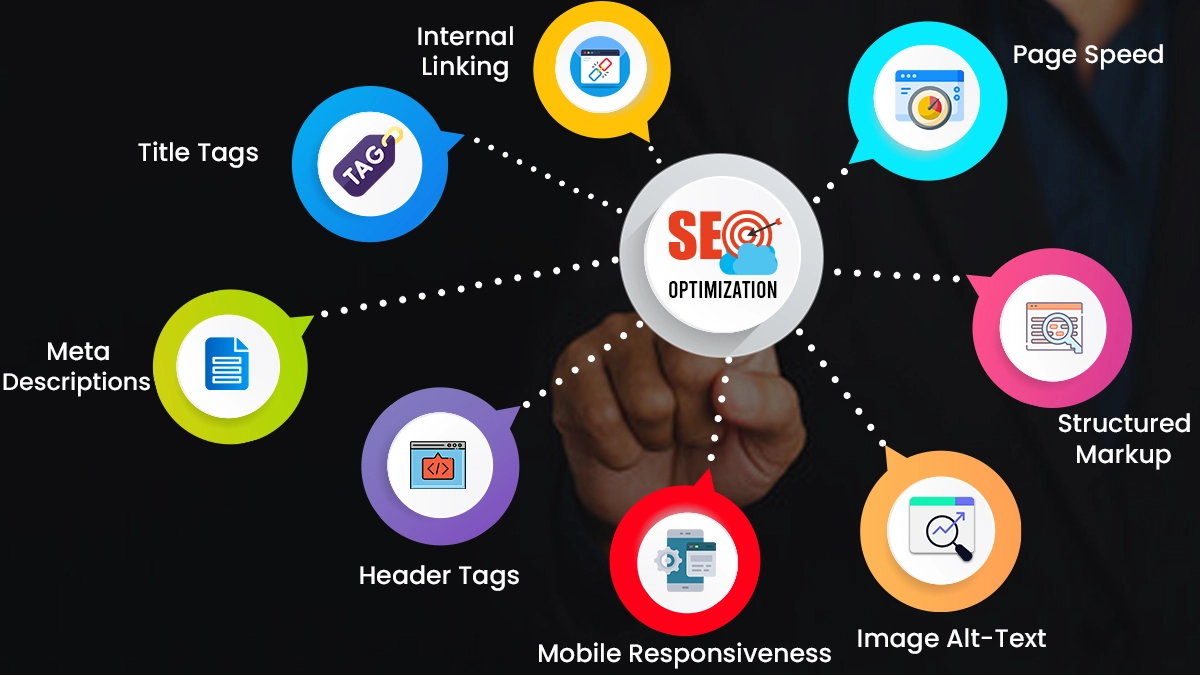
Key On-Page SEO Factors
Here is a list of some of the important On-Page SEO factors that you should consider when you are providing content to your website.
Title Tags and Meta Descriptions
Your title tag is the first impression you give to both users and search engines. It should include your main keyword and be click-worthy. Under 60 characters.
Your meta description is a summary of your page’s content. Not a direct ranking factor but does affect click-through rates (CTR). Write meta descriptions under 160 characters that encourage users to visit your page.
Header Tags (H1, H2, H3)
Use header tags to structure your content in a hierarchical way. Your H1 should be the main topic of your page (usually the same as your title tag), H2 and H3 break down sub-topics. This makes your content more readable and helps Google understand the organisation of your content.
Image Optimisation
Images are important for content engagement but can slow down your page if not optimised. Compress images using TinyPNG and always include alt text that describes the image. Both for SEO and accessibility.
Schema Markup
Structured data or schema markup helps search engines understand your content better and can give you rich snippets. Implement structured data for articles, products, recipes and FAQs using Google’s Structured Data Markup Helper.
Page Speed
Page speed affects both user experience and SEO. Google’s Core Web Vitals puts a lot of emphasis on load times. Use Google PageSpeed Insights to find issues and follow best practices such as:
- Compressing images and files
- Minimising HTTP requests
- Implementing lazy loading for images and videos
- Breaking paragraphs into smaller sections
Mobile Optimisation
Google now uses mobile-first indexing which means it uses the mobile version of your site for ranking and indexing. Make sure your site is responsive and provides a good experience on all devices. You can test your site’s mobile friendliness with Google’s Mobile Friendly Test.
Technical SEO Checklist
Technical SEO is the foundation of your website’s ranking. Without a solid technical base, even the best content will struggle.
Crawlability and Indexability
Make sure your site is crawlable by search engines. Use Google Search Console to check your site’s indexing status. Check for crawl errors, 404 pages and broken redirects.
XML Sitemap and Robots.txt
Your XML sitemap helps search engines find and crawl your pages. Submit your sitemap in Google Search Console and update it whenever you add new content.
Make sure your robots.txt file is set up to prevent search engines from crawling irrelevant pages (like admin pages or cart pages) and allow them to crawl important content.
Core Web Vitals
As mentioned earlier, Google’s Core Web Vitals are important for both rankings and user experience. Optimize for:
- Largest Contentful Paint (LCP): It measures loading performance and you have to target LCP to bring under 2.5 seconds.
- First Input Delay (FID): It measures interactivity and here you have to target to put FID under 100 milliseconds.
- Cumulative Layout Shift (CLS): It measures visual stability and in CLS you have to aim for a score of less than 0.1.
You can check your site’s Core Web Vitals using Google Lighthouse or PageSpeed Insights.
HTTPS and Security
Security is more important than ever. Sites still using HTTP instead of HTTPS are at a big disadvantage. Not only does HTTPS build trust with users but it’s also a confirmed ranking signal by Google. Make sure your SSL is up to date and your site is fully secured.
How to Build High-Quality Backlinks
Backlinks are still among the most significant factors that Google’s algorithm uses when ranking content. Nonetheless, there has been a shift from quantity to quality as evidenced by the penalty placed on unnatural link-building techniques by Google’s updates.
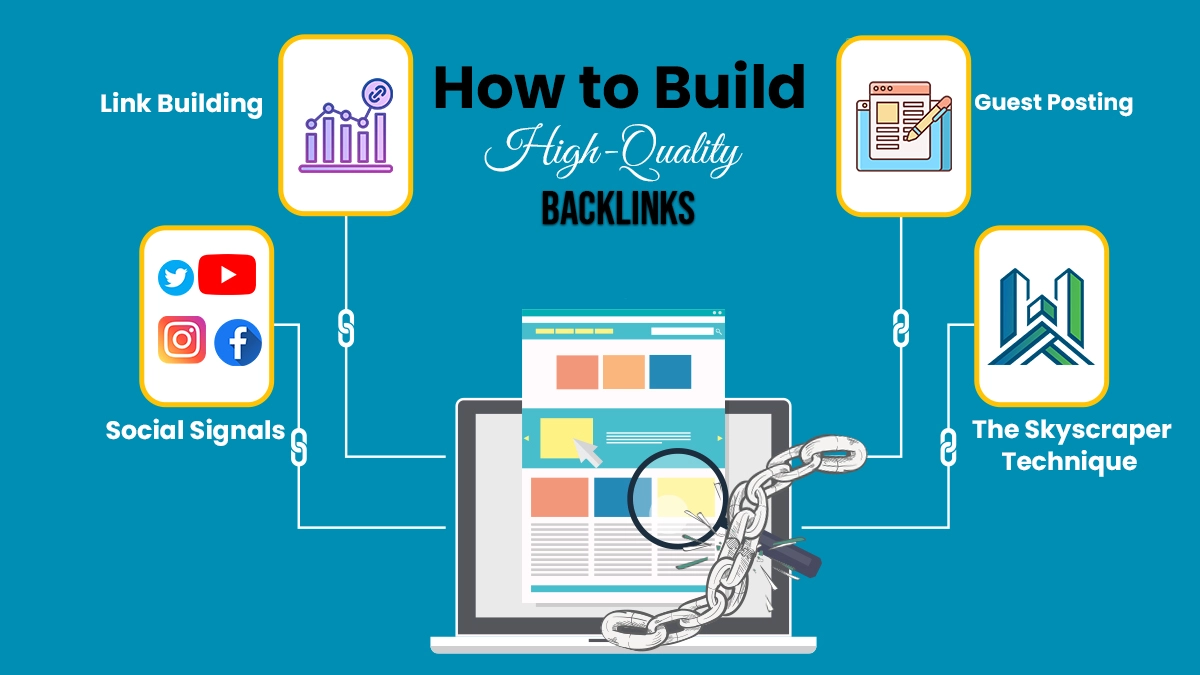
Guest Posting on High-Authority Sites
Writing for high-authority sites in your niche can get you links. A study by Backlinko found that guest posting on high-authority sites is one of the best ways to get high-quality links. For example, writing an article on a well-known industry can drive traffic and increase your credibility.
Broken Link Building
Finding broken links on other websites related to your niche and offering your articles as replacements are called broken link building and with the help of tools like Ahrefs or SEMrush you can discover these possibilities. Google Search Central normally appreciates the offer of replacing a broken link with a relevant piece of content.
The Skyscraper Technique
Popularized by Brian Dean of Backlinko, the Skyscraper Technique is finding content that has already got links and making something better. By offering better content you can then reach out to the sites linking to the original content and suggest they link to your improved version.
Leverage Social Media for Link-Building
While social signals aren’t a direct ranking factor, content that is shared widely on social media often gets links. You can take the benefits of social media marketing by creating shareable content like infographics, videos or insightful blog posts that will increase your reach and chances of getting organic links.
Tools for Monitoring SEO Performance
SEO is not a one-time effort or static. You need to monitor and adjust because regularly analyzing your SEO performance is crucial to staying ahead of the competition and algorithm changes.
Google Analytics
This will give you loads of data on how users are interacting with your site including bounce rate, average session duration and user demographics. Use this data to tweak your content and SEO. For example, if you have a high bounce rate it means your content isn’t meeting user expectations so review your targeting keywords, intent and content quality.
Google Search Console
This is where you track your site’s performance in Google’s search results, see which keywords are driving traffic, find any crawl errors and how Google sees your site. Also great for monitoring any manual penalties that could be affecting your rankings.
Moz
Moz has a range of tools for tracking your rankings, domain authority and link profile. Use these tools regularly and you will spot trends and potential issues before they become major problems.
SEMrush and Ahrefs
Both are trending/leading tools where you can track ranking, site health score and do competitor analysis. These tools help to improvise content as per user-searched keywords.
Adapting Future SEO Trends
SEO is always changing, so it demands flexibility and regular updates of your sites. So here are the latest trends to watch out for in 2024 and 2025:
AI and Machine Learning
Content that is semantically relevant and contextually rich will do better as Google continues to improve its AI-driven search algorithms like RankBrain and MUM (Multitask Unified Model). Instead of focusing on keywords, optimize your content for broader topics and themes.
Voice Search Optimization
By 2025 voice search will make up over 60% of all searches. So you need to optimize for natural conversational keywords and long tail queries that reflect how people speak.
Local SEO
For businesses with a physical presence, local SEO is key. Claim and optimize your Google My Business profile, get positive reviews and make sure your NAP (Name, Address, Phone Number) is consistent across the web.
Video Content
Video content is getting more important for SEO. YouTube is second only to Google in terms of search volume and Google often shows video snippets in search results. Create and optimize video content to support your written content.
Conclusion
Being able to rank high on Google organically in 2024 can be achieved through a variety of methods that involve comprehensive knowledge of Google’s algorithm changes, thorough keyword investigation, user intention material optimization, strong technical SEO, and quality backlinks formation. The area is constantly changing, and those who are aware and change their approach will have the best success. To stay one step ahead you have to regularly read SEO-related blogs that will help you understand, how to improve SEO to rank your website higher on Google.
